
MAi Plato
Pondering My Relationship With Ai

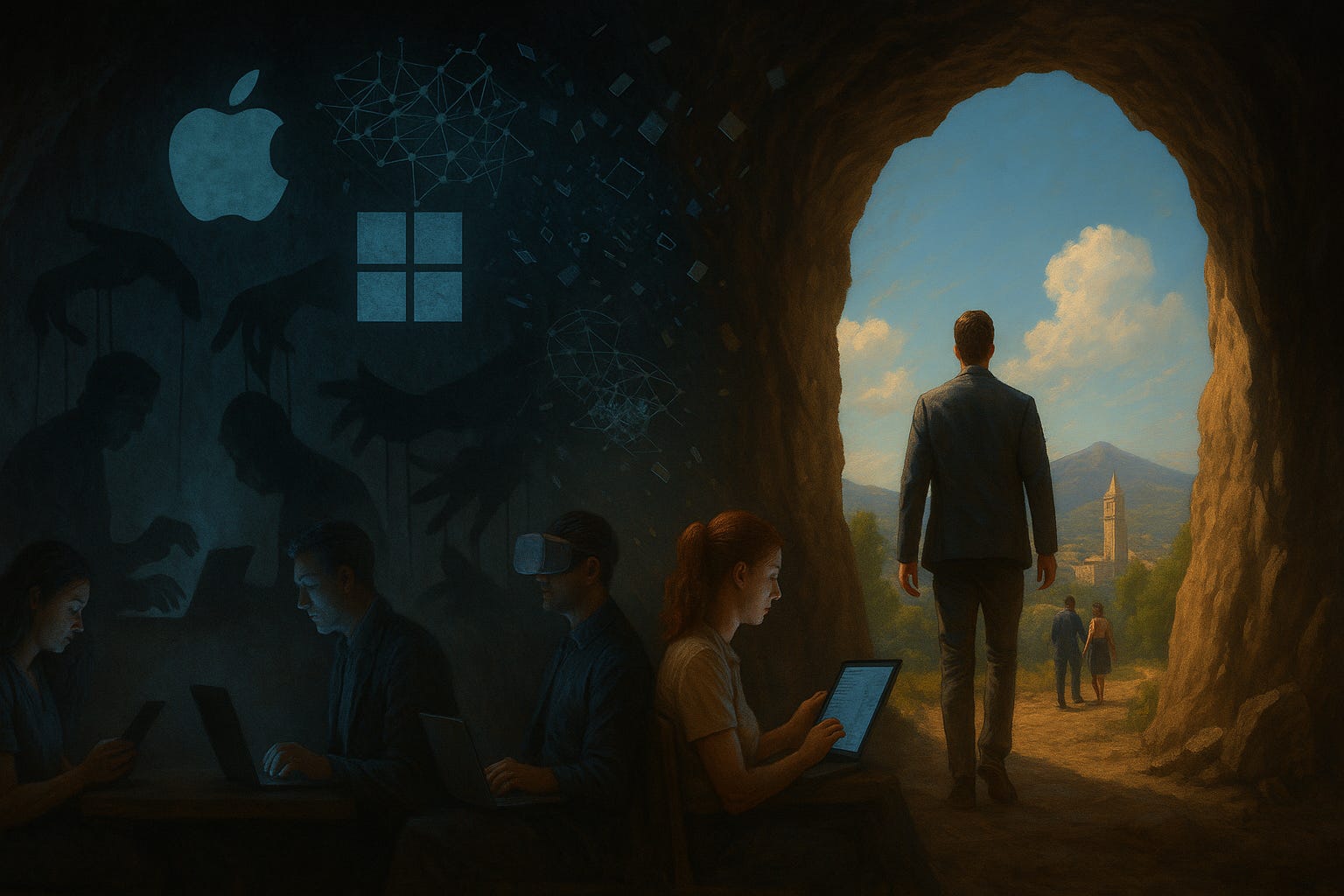
Imagine a world where what you see and hear isn’t the whole truth. With the rapid evolution of artificial intelligence and our insatiable demand for new technologies, we have beyond blurred our reality. I personally have been using AI daily for over 3 years and have given my inherent, committed trust to Microsoft, Apple and a little bit of you, Google. Now I live in your world. A world where what’s starting to feel real is only a reflection, carefully shaped and projected onto the walls of ‘your’ perception.
This isn’t science fiction. It’s the world we live in today. And surprisingly, it mirrors a story told over two thousand years ago by the philosopher Plato. I remember first hearing this story in an Oak Park high school class. It prompted me to question how I perceive my reality, and it came to mind recently when I was thinking deeply about my/our relationship with AI. So let’s go back in time and take a moment to explore Plato’s famous allegory of the cave and how it offers a chillingly accurate lens through which to view our relationship with generative AI.
Inside the Cave…
In the written dialogue w/ Socrates and several interlocutors called The Republic, Plato describes prisoners who have been chained inside a dark cave since birth. They can only see the wall in front of them. Behind them, a fire burns, and between the fire and the prisoners, people walk along a path holding up objects. These objects cast shadows on the wall.
To the prisoners, those shadows are reality. They have never seen anything else.
One prisoner is eventually freed. At first, he is blinded by the light outside the cave. But as his eyes adjust, he sees the real world for the first time, sees the sun, the sky, living people, real people. When he returns to tell the others, they do not believe him. They ridicule him. The shadows are more comfortable.
Plato’s allegory is a powerful metaphor for how we confuse appearances with truth and how painful it can be to step outside the familiar.
Welcome to the Modern Cave…
Fast forward to today. Our cave is digital, silicon-coated. It’s made of screens, algorithms, platforms, and models, oh how we lust the models. Generative AI, a tool that produces text, images, videos, and voices. Now plays a central role in how we consume and create content.
The shadows on our walls are no longer cast by fire. They are generated by massive language models trained on terabytes of human data. They look and sound more convincing than ever.
But they are still shadows.
The New Puppeteers…
In Plato’s cave, the puppeteers control what the prisoners see. Today, the puppeteers are a mix of software developers, prompt engineers, corporations, and algorithms optimized for engagement and profit.
What we see is curated. What we don’t see is just as important.
And often, what is generated feels real. But it is stitched together from probabilities, not truths.
The Fire Behind the Curtain…
Just as the fire in the cave made the shadows possible, the source of generative AI’s content is its training data and architecture. It’s powerful, no doubt. But it doesn’t know us. It doesn’t understand the world. It only mimics our language, our art, our behavior. An approximation of ‘intelligence’.
This is not inherently bad. It’s just not reality.
Escaping the Cave…
So how do we step outside?
It starts with awareness. We must recognize when we’re consuming an illusion. Ask questions about how content is made. Think critically about what is generated and why it appears the way it does.
Those who question the cave often sound alarmist. But like Plato’s freed prisoner, they are simply trying to remind us that we are looking at shadows.
This doesn’t mean we abandon generative AI. It means we use it with care, clarity, and humility. It means we collectively and consciously work hard to ensure that our fire burns brighter than the growing glow of Ai.
In Search of the Sun…
Plato believed that truth and wisdom live outside the cave. That our journey should lead us toward what is real, even if it’s uncomfortable at first.
Today, the journey is not away from technology but through it. With our human eyes wide-open.
Let’s not mistake the pulsing glow of the screens/tech that is projecting AI’s outputs for sunlight. Let’s use these new tools wisely, but never forget to step outside and see for our human selves.